Can You Put a Refrigerator in a Dumpster? (Why You Shouldn't)
Technically possible in narrow circumstances — but almost always illegal without professional refrigerant recovery first. Here's what federal law actually says, what dumpster companies allow, and the five legal alternatives that cost you nothing.
It seems like the obvious solution: you have a dumpster in the driveway, you have an old refrigerator taking up space, why not just put one in the other? The short answer is that in the overwhelming majority of situations, this is illegal — not just against dumpster company policy, but a potential federal violation. Before you move that fridge anywhere near a dumpster, here's what you need to understand.
Why Refrigerators Can't Go in Most Dumpsters
The core issue is refrigerant. Every refrigerator — and every freezer, window AC unit, and dehumidifier — contains refrigerant gas that circulates through the compressor and cooling coils. These gases are federally regulated under the EPA Clean Air Act, Section 608.
Older refrigerators manufactured before 1995 typically use R-12 (Freon), a chlorofluorocarbon (CFC) that depletes the ozone layer and is classified as an ozone-depleting substance under the Montreal Protocol. Newer units most commonly use R-134a (a hydrofluorocarbon) or R-600a (isobutane), both of which are potent greenhouse gases with global warming potential many times higher than CO2.
Federal law under Section 608 makes it illegal to knowingly vent these refrigerants into the atmosphere. The fine structure is serious: up to $44,539 per violation per day. When a refrigerator is tossed into a dumpster and crushed at a landfill or transfer station, the refrigerant vents. That's the violation.
This is why refrigerant recovery must happen before any disposal — and it must be performed by an EPA Section 608 certified technician using certified recovery equipment.
What Dumpster Rental Companies Actually Say
Check the terms and conditions of any major dumpster rental company — Waste Management, Republic Services, Dumpsters.com, Redbox+, or any regional operator — and you'll find refrigerators explicitly listed in the prohibited items. This isn't arbitrary policy. It's because:
Dumpster companies face direct liability if their containers carry refrigerant-containing appliances to a facility that isn't equipped to handle them properly.
Transfer stations and landfills that receive refrigerant-containing appliances without recovery documentation can face regulatory action.
Some states impose additional requirements on waste haulers who transport refrigerant-containing equipment.
If you toss a refrigerator in a rented dumpster without telling the company, you've violated your rental agreement. Many companies explicitly state they will charge additional fees — often $50–150 or more — for prohibited items found in the container. And that's on top of any regulatory exposure.
What About Roll-Off Dumpsters?
Roll-off dumpsters — the large open-top containers used for construction projects and major cleanouts — follow the same rules. The size of the container doesn't change the federal refrigerant regulations. Roll-off operators who accept CFC-containing appliances without refrigerant recovery documentation can face fines from state environmental agencies and the EPA.
Some contractors and homeowners assume that because roll-off dumpsters handle demolition debris — which often includes appliances pulled from kitchens and laundry rooms — refrigerators must be acceptable. They're not, at least not without prior refrigerant recovery. On commercial demolition sites, a certified HVAC technician recovers refrigerant from all applicable appliances before any demolition work begins. That step is legally required.
State-Specific Regulations
Federal EPA rules set the floor — states can and do impose stricter requirements:
California. CalRecycle regulations prohibit disposal of refrigerant-containing appliances in solid waste facilities. California also has extended producer responsibility rules and mandatory retailer take-back programs for certain appliances.
New York. The state Department of Environmental Conservation has specific regulations for appliance disposal that supplement federal rules, and municipalities in New York are required to have appliance recycling programs in place.
Massachusetts. Refrigerators and other white goods are banned from Massachusetts landfills and transfer stations entirely. Certified recyclers are required to demanufacture them properly before any materials go to disposal.
Illinois. The Illinois Environmental Protection Agency enforces refrigerant management rules aggressively and has specific guidance for both commercial and residential appliance disposal.
If you're outside these states, your state almost certainly has some version of appliance disposal regulation. Check with your state's environmental agency or local waste authority before assuming any disposal method is permitted.
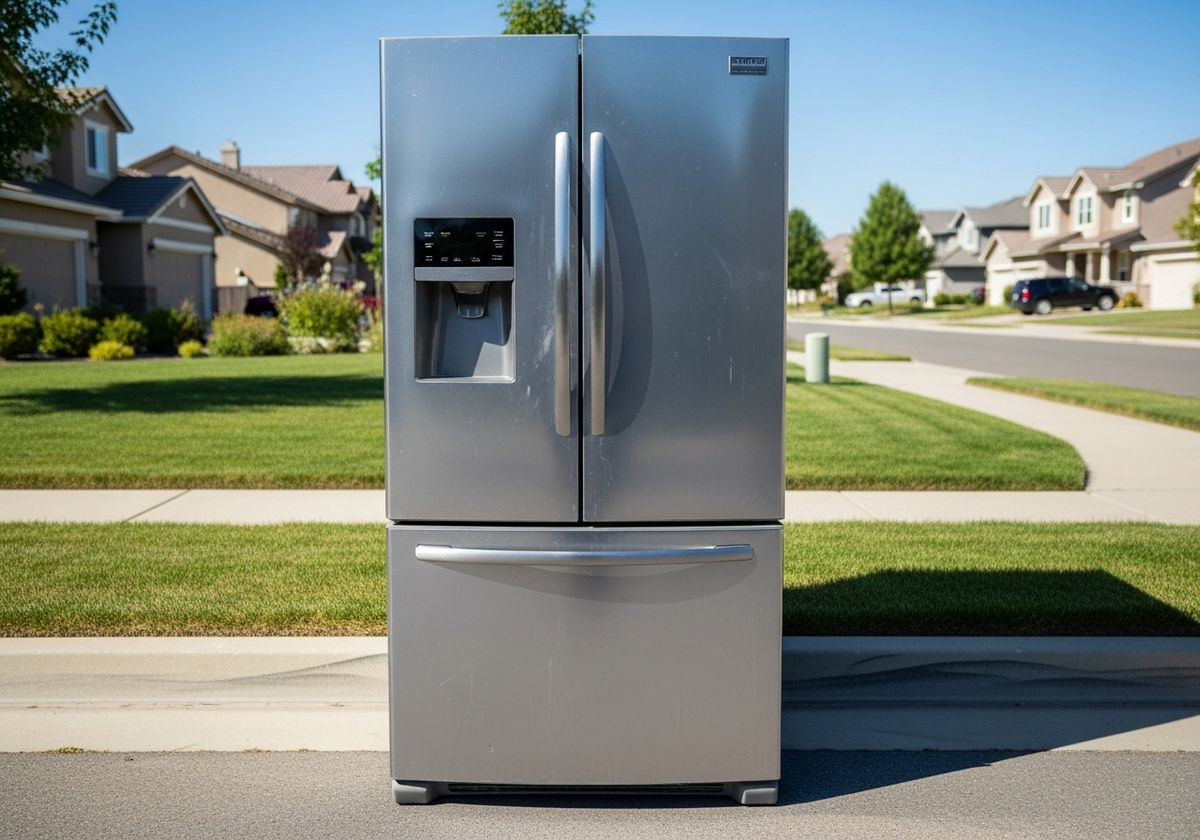
Refrigerators cannot go in a dumpster until an EPA Section 608 certified technician recovers the refrigerant
Can You Ever Legally Put a Fridge in a Dumpster?
There is one legal pathway: if the refrigerant has been professionally recovered and documented before disposal, the appliance no longer contains regulated substances and can theoretically go into a dumpster.
In practice, this requires:
Hiring an EPA Section 608 certified technician to recover the refrigerant using certified recovery equipment.
Obtaining documentation certifying that the refrigerant has been removed.
Some states additionally require a physical tag or sticker affixed to the appliance certifying recovery before any hauler will accept it.
The cost of hiring a certified technician for refrigerant recovery from a single residential refrigerator typically runs $50–150. At that point, you've eliminated the only reason to use a dumpster in the first place — you're paying someone, so you might as well pay a junk removal company or, better, use a free appliance pickup service that handles certified recovery at no cost.
The simplest legal alternative: free pickup handles refrigerant recovery and disposal at no charge
What to Do Instead
There are five legitimate options for disposing of an old refrigerator, several of which are completely free:
Free appliance pickup service. Services like AppliancePickupNow send a crew to your home, handle the refrigerator from wherever it's located, and process it through certified channels — refrigerant recovery included. Cost to you: $0. This is the easiest and fastest option for most homeowners. See refrigerator pickup details.
Retailer haul-away. If you're buying a new refrigerator, the retailer (Home Depot, Lowe's, Best Buy, and most appliance stores) will haul away your old unit. Some do this free with delivery; others charge $20–40. This only works when you're buying a replacement at the same time.
Utility rebate program. Many electric utilities run appliance retirement programs that will pick up your working old refrigerator or freezer for free — and sometimes pay you a $25–75 rebate. Check your utility's website or ENERGYSTAR.gov for programs in your area.
Donate a working unit. If the refrigerator still runs, organizations like Habitat for Humanity ReStores, local food banks, and community organizations sometimes accept working appliances. This requires the unit to be fully functional and in reasonable condition.
Scrap yard drop-off. If you have a truck or can rent one, scrap yards accept refrigerators — but they will recover the refrigerant themselves before processing. Some scrap yards pay a small amount for the metal; others charge a small fee for appliances because of the refrigerant handling cost.
The enforcement reality: most individual homeowners who toss a refrigerator in a dumpster don't face immediate consequences. The regulatory system isn't watching every dumpster. But the exposure is real:
Neighbors or waste facility workers may report it. Waste industry employees are trained to identify refrigerant-containing appliances.
If the dumpster rental company discovers it, they may charge additional fees and report the violation to protect themselves from liability.
EPA enforcement actions can result from tips. The agency does pursue cases involving illegal refrigerant venting, and civil penalties can be issued even for single-appliance violations at the residential level.
State environmental agencies in stricter states actively enforce appliance disposal rules, especially during waste audits at transfer stations.
Beyond the regulatory risk, it's worth noting that the refrigerant in a single old refrigerator can have a global warming equivalent of hundreds to thousands of pounds of CO2. Proper recovery keeps that out of the atmosphere. The free legal alternatives are easy enough that there's no reason to take the risk.
Frequently Asked Questions
Is it illegal to put a fridge at the curb?
It depends on your municipality. Many cities and counties prohibit placing refrigerators at the curb for standard garbage pickup because sanitation workers are not equipped to recover refrigerant. Some municipalities offer scheduled bulk pickup with certified appliance handling — check your local waste authority's website. Simply leaving a refrigerator at the curb in most urban areas violates local ordinances and can result in fines.
What about a mini fridge — does it have the same rules?
Yes. Mini fridges and compact refrigerators contain the same types of refrigerants as full-size units — typically R-134a or R-600a (isobutane). The EPA regulations apply regardless of the appliance's size. A mini fridge that ends up in a landfill without refrigerant recovery is the same legal violation as a full-size unit.
Can I remove the refrigerant myself?
No. The EPA Clean Air Act Section 608 prohibits anyone other than a certified technician from venting or recovering refrigerant from a refrigeration system. Attempting to vent refrigerant yourself — even in a well-ventilated area — is a federal violation. This applies to both ozone-depleting substances like R-12 and greenhouse gases like R-134a.
How do I find a certified refrigerant recovery technician?
EPA Section 608 technicians are certified through organizations like ESCO Group (HVAC Excellence) or Mainstream Engineering. HVAC companies, appliance repair shops, and refrigerant recovery services are the most common sources. However, the simplest approach for a single residential refrigerator is to use a free appliance pickup service — they handle certified refrigerant recovery as part of their standard process at no cost to you.
Dispose of Your Fridge Legally — for Free
Local haulers handle certified refrigerant recovery and eco-friendly processing. Working units get refurbished and resold; the rest is recycled for scrap — that's how your pickup stays free. No fees, no paperwork for you — just submit a request and a hauler will call or text you within 24 hours. Disconnect the fridge and move it curbside or outside the garage before pickup day to keep things moving.